This week readings were particularly engaging in their discussion of women’s power. Sexton’s poem celebrates women by illustrating a women’s admiration for her uterus. The uterus is the women’s womb, which contains and nourishes a fetus. What is important about this poem is that she is demonstrating a positive, open dialogue about a woman’s body when this was not something normally discussed.
I found it interesting that she personifies her uterus, giving it its own identity:
“in celebration of the woman I am
and of the soul of the woman I am
and of the central creature and its delight
I sing for you”
She also wants women to love their bodies as seen in the following metaphor:
“Hello to the soil of the fields.
Welcome, roots.” (17-19)
She equates soil as essential for growth reflecting idea that women have a strong place in society. The uterus is masked as the foundation of humankind.
I like how she focuses on women joining together since they are all connected by their bodies (similar to Fausto-Sterling’s reading who sees all women struggling in society because of their reproductive system) and the uterus as an essential component that links them together. The poem is crucial in not just embracing a body but goes further in reflecting ideas about society in terms of women’s power.
Sexton’s poem reflects on ideas in Fausto-Sterling’s reading. Fausto-Sterling discussed the belief that women’s productive functions made the unsuitable for higher education. Women’s systems were viewed as abnormal. The fact that menstruation casts such a “dark shadow on women’s lives,” reflects the idea that we need to “know more about it—how it works, whether it can be controlled (91). These ideas relate to Sexton’s poem that calls for an admiration of the uterus and the need to unite and understand women’s power. The “advent of women’s health movement” (95) brought women together and helped redefine these definitions. As medical technology improves, more studies investigate the menstrual cycle and other hormonal changes that occur within the women’s body. The new research shows the “dynamic component of our existence” (121), reflecting Sexton claim that we must see women’s existence as positive.
It was also a good idea to group Valdes with these previous readings since Valdes gives a perspective coming from a different point in history, the third wave of feminism. In “Ruminants of a Feminist Fitness Instructor” Alisa Valdes gives a view of feminist identity as unclear and contradictory when it enters mainstream society. She tells her story of her job as a fitness instructor and explains she like her job because it gave her power.
I was shocked that she writes we comprise a “third-world nation within the boarder of our own developed country.” She argues that the fact women are obsessed with their bodies maintains their own position as “second-class” citizens. I think she is too harsh on this analysis. Women have made great strides in society and have accomplished a great deal which should in no way be glossed over. Despite that women still earn less and men, I think we as a society are slowly addressing the issue and approaching equality between women and men. Just take a look at Michelle Obama and Oprah Winfrey to name a few. They are incredibly successful women who have and continue to make beneficial changes to our society.
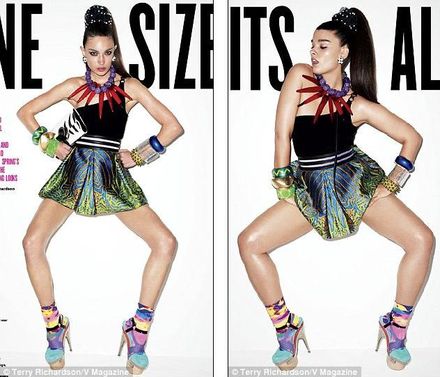
Valdes’ reading made me think about the reason women go to the gym, a topic which we discussed in class on Tuesday. I personally see it as a positive way to maintain a healthy lifestyle but others may argue that the need to be thin is what is forcing women to dedicate hours on end up construct what the media sees as a “perfect body.” Is it because of media’ influence that women should be thin? Just take a look at the ultra thin models on the runway. How can we change this? V Magazine certainly put things into perspective by putting side by side a size 2 model and a size 16 model. The goal was to show that good fashion can look good on someone of any size. What do you think?

I agree with the main idea of this post-- one of the interesting things about the reading that was due for Thursday is that it focused on women's physical body. After reading Fausto-Sterling's article, I could not believe how much people relied on the physical body of a woman compared to a man, not just their brain, but their menstruation cycles, menopause, etc in terms of their abilities and men's superiority because of the way our bodies are made. Is there any way to overcome these stereotypes of the qualifications of women when it is based in our anatomical make up? how can it be seen as though our bodies are different, but both are normal?
ReplyDeleteI agree that women are not just making themselves second class citizens by caring about the way they look; there are many aspects of our lives that center on the way we look and feel about ourselves that don't include approval by men. However, I do find it interesting that some women go to the gym in order to look like the models they see in magazines and on TV. In reality, these models are likely very unhealthy. The gym is supposed to be a place to go to IMPROVE our health...and healthy women are curvy, strong, and confident...not stick thin. Women need to realize that the job of the models they see is to look a certain way...but fortunately, we don't have that pressure. Our only responsibility is to ourselves, and I think that is a privilege...we should embrace our bodies and our health and stop comparing ourselves to who we see on TV.
ReplyDeleteOur society definitely pressures young girls to be skinny. It is hard to love your own body when it does not "match up" to those on TV or in magazines. As for the V Magazine Ad, I think the outfit looks the same on both models. However, I was surprised to see that the "size 16 model" did not look that much bigger than the size 2. I showed this image to my roommate and she only thought there was a 4 size difference. I have a hard time believing that the model on right is a size 16.
ReplyDelete